
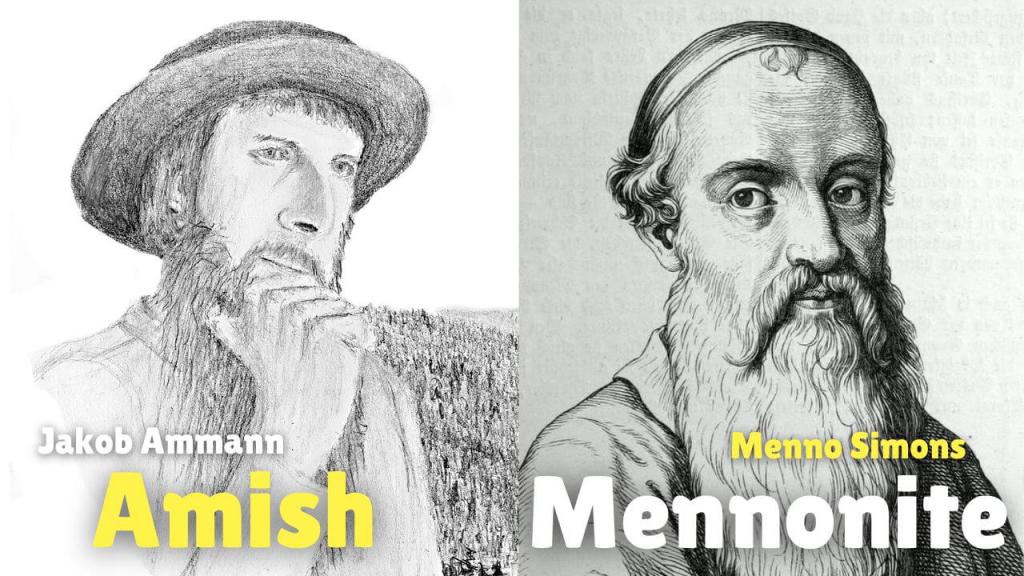
So, what’s the difference?
Martin Luther started it all in 1517 quite unintentionally. He didn’t realize how farreaching his statements would be when he criticized the established church for imposing indulgences to grant full or partial remission of the punishment of sin. But because of the invention of the printing press, his statements spread like wildfire.
One thing Luther did not address was the practice of infant baptism. Other outspoken leaders who got their impetus from Luther, did challenge infant baptism and were called “anabaptists” meaning “another baptism”. There were many influential leaders in this group, such as, Calvin and Zwingli. During this time it was against the law to be baptized a second time, a crime punishable by death. Hence there were many martyrs who died by the hands of the established Church. Anabaptists repudiated their first baptism and only held to a baptism signifying their confession of sin and faith. Therefore, they did not consider themselves as “anabaptists” since there is only one baptism, that of an adult by faith in Jesus Christ.
Another practice which separated these Anabaptists from the Church was advocating the authority of the Scriptures in personal and church life. Menno Simons, originally a Catholic priest, had a problem with saying that Christ was literally present in the bread and wine of the Eucharist. This led him to study the Scripture and Luther’s writings more. He came to agree with the others that the Scripture ought to be the prime authority in the life of a believer and in the church.
Menno Simons did not found the Mennonite Church, but through his leadership and writings he was able to clarify the throughts of the Anabaptist movement. His studies moved him on to questions about infant baptism, church membership, and the conversion experience – faith in Jesus as Lord. It was followers of his writings and teachings who began to call themselves Mennonites.
When Mennonites began emigrating to other countries, Poland being one of them, they would draw up an agreement with the new country that they could maintain their own churches and schools, keep their language to be taught in their schools and used in their businesses, and receive exemption from military service. Most Anabaptists were pacifists and opposed force to maintain social order.
Towards the end of Menno Simons life, he was troubled by some of his own people who were pressing for stricter use of the ban (expulsion from the church) as a means of discipline. This brought about the beginning of the Amish, followers of the man named Jakob Ammann. He presented a much stricter code of living… “church members should dress uniformily, that beards should not be trimmed, and that it was wrong to attend services in a state church.” (https://www.britannica.com/topic/Amish) Many Amish began to emigrate to North America in the early 18th century.
Since then, there have been many branches of Mennonite and Amish spring up. There’s Old Order, New Order, and various named groups of Amish, all easily distringuishable to people acquainted with the groups. There are Old Mennonites, General Conference Mennonites, Mennonite Brethern, and others that have branched out from Mennonites such as Holdemans, Hutterites, etc. There are also groups who have dropped the Mennonite name but still hold to the basic tenets of faith espoused by Menno Simons…salvation by faith in Jesus Christ, the authority of Scripture in a person’s and church’s life, and baptism by adults who profess their faith in Jesus Christ. They claim to be followers of the Word of God and not followers of a man, Menno Simons. They do not enforce outward legalistic regimen but encourage inward submission to God.
In my story, The Long Trek, the Mennonite community in Prussia is faced with the government reneging on their promise of military exemption and enforcing taxes to support the military for the privilege of military exemption. They had a delegation from their community travel to Moscow to meet with the Russian government to obtain their guarantees of religious freedom, right to maintain their own schools using their own language, and for military exemption. The Russian government was quite willing to offer these guarantees and kept these promises until around the 1870’s. At that time they retracted the promise for military exemption and the right to run their own schools. This prompted another major migration from Russia to North America.







 Marilynn Lester
Leave a reply to ponderosapapa Cancel reply